


There is a specific moment in Anthropic's amended S-1 filing that illustrates the central tension of the AI infrastructure era. In the second quarter of 2026, the company reported $974 million in operating income the first operating profit in any period the filing documents. Three months later, in Q3, that number had inverted entirely: a $567 million operating loss. The culprit, as Anthropic explained in the filing, was $5.0 billion in compute purchased under short-term commitments, which the company stated costs "significantly more than comparable multiyear arrangements."
This is the story the amended prospectus tells: a company scaling revenue at extraordinary speed while navigating the extraordinary cost of the hardware that makes that growth possible. The numbers are vast. The dynamics are instructive. And the strategy emerging from the filings offers a window into how frontier AI labs are managing one of the most capital-intensive buildouts in technology history.
Revenue at Velocity: From $41 Million to $33 Billion in Three Years
Anthropic's revenue trajectory, as documented in the amended filing, reads like an exponent exercise. The company generated $41 million in 2023. That grew to $386 million in 2024, then $4.6 billion in 2025. For the first half of 2026 alone, the figure reached $16.3 billion a 1,300% increase over the same period a year earlier, according to Kepler's analysis of the S-1 filing. The September quarter added roughly $17 billion more, bringing nine-month revenue to $33.24 billion, up approximately 1,200% from the same stretch in 2025.
The quarter-by-quarter acceleration tells its own story. Q1 2026 revenue grew 132% compared to the prior year. Q2 accelerated to 144% growth. By Q3, the year-over-year comparison showed 1,127% growth, but the sequential picture softened: approximately 47% quarter-to-quarter increase, a marked deceleration from the prior two quarters' 144% and 132% sequential jumps.
This inflection in growth rate matters. As CNBC reported on the amended filing, revenue growth "slowed on a quarter-to-quarter basis" in Q3. The question observers were asking by November 2026 was whether this represented a natural maturing curve or something else a demand signal meeting a supply constraint, perhaps, or simply the law of large numbers catching up with a company that started from a relatively small base.
The $5 Billion Compute Bill That Erased a Profit
Whatever the revenue dynamics, the cost side of Anthropic's ledger carries the more striking narrative. In Q2 2026, the company achieved $974 million in operating income the first operating profit in any reported period. By Q3, that had become a $567 million operating loss. The swing of approximately $1.5 billion between profitable and unprofitable quarters traces directly to compute costs.
Anthropic stated in the amended filing that its Q3 operating loss was "primarily driven by $5.0 billion of compute under short-term commitments," according to Business Insider's analysis of the disclosure. The company characterized these short-term arrangements as significantly more expensive than multiyear commitments.
The math is concrete. Compute and infrastructure charges reached $9.9 billion in Q3 a fourfold increase from the same period one year prior, as documented in the amended filing. This is not merely a function of scale. The hardware required to train and serve frontier models carries lead times that can stretch across years. When demand spikes faster than contracted capacity comes online, companies face a choice: wait, or pay a premium for immediate access.
Short-term commitments fill that gap. They provide flexibility. They ensure continuity of service. They also, as Anthropic's own numbers demonstrate, can erase operating margins almost entirely.
The Commitment Stack: $895 Billion in Infrastructure Obligations
The amended S-1 provides the first comprehensive picture of Anthropic's infrastructure obligations. The filing discloses approximately $895.4 billion in committed spending on compute and infrastructure, with nearly half expected by the end of 2030. This figure represents the company's contracted minimums the spending it has promised regardless of utilization rates.
Breaking down the commitment structure reveals deliberate layering. Agreements with seven compute providers that the S-1 puts a dollar figure on total approximately $637 billion: roughly $431 billion in minimum spend or lease rent, and about $206 billion in "up to" or pay-on-delivery amounts. Beyond these fixed commitments, Anthropic has estimated $125 billion to $150 billion in additional TPU capacity and more than $20 billion in AMD systems if it purchases the full initial capacity. Neither of these latter figures carries a fixed dollar commitment in the filing.
The scale is difficult to contextualize against historical technology buildouts. As Shattered's analysis of the amended filing notes, the "$895.4 billion of committed compute and infrastructure spending" represents "agreements far larger than its revenue." The company is, in effect, pre-purchasing access to computational capacity years before that capacity may be fully utilized.
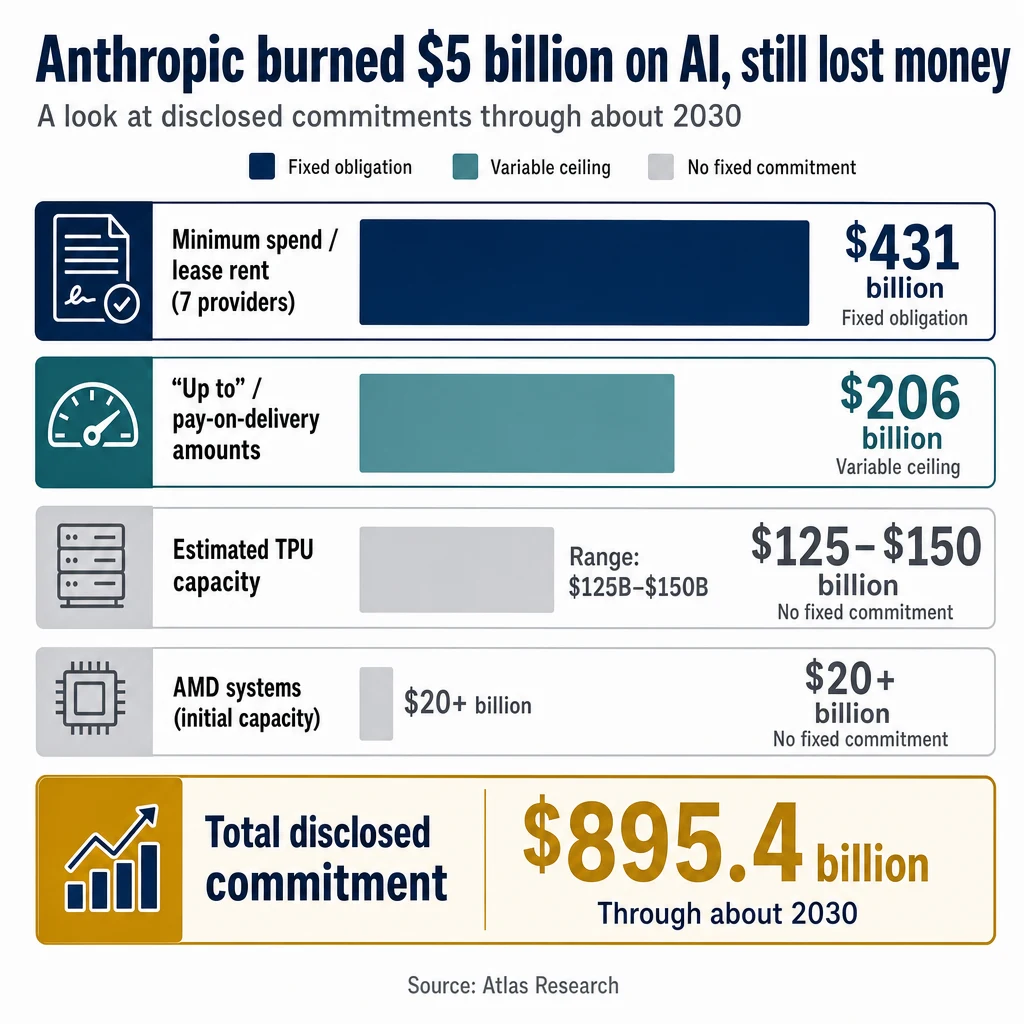
| Commitment Category | Estimated Value | Commitment Type |
|---|---|---|
| Minimum spend / lease rent (7 providers) | $431 billion | Fixed obligation |
| "Up to" / pay-on-delivery amounts | $206 billion | Variable ceiling |
| Estimated TPU capacity | $125-$150 billion | No fixed commitment |
| AMD systems (initial capacity) | $20+ billion | No fixed commitment |
| Total disclosed commitment | $895.4 billion | Through ~2030 |
Why Long-Term Commitments Change the Equation
The contrast between Anthropic's Q2 and Q3 results illuminates a strategic choice that extends well beyond any single quarter. In Q2, the company achieved its first operating profit. The mechanism behind that profitability, as the S-1 shows, involved compute costs falling from 201% of revenue in the first half of 2025 to 55% in the first half of 2026.
That compression did not happen because demand softened. It happened because the company had contracted for capacity under arrangements that spread costs over time. Long-term commitments carry their own risks overbuilding, technology obsolescence, inflexible capacity but they carry a specific financial advantage: the per-unit cost of compute under multiyear agreements is demonstrably lower than equivalent capacity purchased on short-term markets.
Anthropic's disclosure that $5 billion in short-term commitments "costs significantly more than comparable multiyear arrangements" is not merely a financial observation. It is a data point in an ongoing strategic calculation. The company is managing a portfolio of commitments that includes both types fixed long-term obligations that provide cost predictability, and shorter-term arrangements that provide flexibility. The quarterly swing from profit to loss suggests that the balance tilted, briefly, toward the expensive end of that spectrum.
The pattern implies a mitigation strategy embedded in the commitment structure itself: lock in capacity at favorable rates where possible, accept the premium for short-term flexibility where necessary, and monitor the ratio as the business scales. This is not unique to Anthropic. The broader AI infrastructure race has driven frontier labs into similar arrangements. Reports indicate that OpenAI is evaluating up to $30 billion at a $1.25 trillion valuation, as noted in Tech Insider's coverage of the filing. The economics of AI infrastructure have become an industry-wide calculation.
The Net Loss Picture: Accounting Versus Operations
For readers evaluating Anthropic's financials, distinguishing between operating losses and net losses matters considerably. The nine-month net loss of $104 billion $80.7 billion in the first half alone makes for a striking headline. But most of those losses are accounting artifacts rather than cash expenditures.
Approximately $72.4 billion of the first-half net loss traces to non-cash charges related to changes in the fair value of convertible notes, as the company marked up these financing instruments as its valuation rose. This is not money leaving the building. It is a reflection of how the company's own valuation changed between funding rounds, recorded as an expense on the income statement under current accounting standards.
The operating line tells a different story. Operating cash flow was positive at $3.9 billion for the first half of 2026, as Kepler's analysis documents. The company is generating cash from operations. The net loss is driven by fair-value accounting, not by the day-to-day cost of running the business.
This distinction shapes how to read the Q3 swing. The $567 million operating loss reflects real economics compute purchased and consumed, revenue earned, costs incurred. The $23.29 billion net loss for the quarter includes the same fair-value adjustments that drove the first-half numbers. They are not the same thing, and treating them as equivalent would overstate the company's cash burn significantly.
What This Means for Anthropic Readers
For practitioners evaluating AI infrastructure economics, Anthropic's amended filing offers a case study in the tradeoffs that define the current moment. Short-term compute commitments provide flexibility and immediate capacity. They also carry a premium that can eliminate operating margins almost overnight. Long-term commitments provide cost predictability and lower per-unit economics. They also create obligation floors that require accurate demand forecasting and carry the risk of stranded capacity if growth slows or technology shifts.
Anthropic's disclosed strategy layered commitments across multiple providers, fixed and variable structures, multiyear time horizons suggests an attempt to balance these considerations rather than maximize either flexibility or cost efficiency alone. The company achieved operating profit in Q2 when its cost structure aligned with its revenue. It recorded an operating loss in Q3 when short-term premiums dominated a single quarter's economics. Neither state is permanent. The goal appears to be a portfolio of commitments that, over time, produces consistent operating margins as revenue continues to scale.
The $895.4 billion in disclosed commitments also signals something about perceived demand trajectories. Companies do not contract for nearly a trillion dollars in infrastructure without expecting to need it. The commitments reflect a hypothesis about where revenue will be in three, four, five years not just where it is today.
Governance and the Public Market Question
Anthropic filed its S-1 with the U.S. Securities and Exchange Commission on October 26, 2026, naming the Nasdaq as the venue and "ANT" as the ticker. The amended filing on November 2 added Q3 financials, completing the picture for potential public investors. As of the filing date, the company reported a valuation of approximately $2 trillion.
The prospect of a public Anthropic raises governance questions that extend beyond typical IPO considerations. The company's stated mission includes attention to existential risk from advanced AI a focus that shapes its research agenda and corporate structure. How public market investors will evaluate that mission alongside quarterly financial performance remains an open question. The S-1 includes language addressing these risks, as Tech Insider's analysis of the filing documents.
Anthropic also disclosed $2 billion in non-cash charges related to its donation-matching program, where employees can pledge equity awards to charitable causes and the company matches pledges with non-voting Class N shares. This structural choice allowing employees to direct value to charitable causes while preserving the company's governance structure reflects values embedded in the organization's formation.
Looking Ahead: The Compute Commitment Cycle
The amended S-1 closes some gaps and opens others. Investors now have Q3 data. They have the nine-month revenue picture. They have a fuller accounting of infrastructure obligations. What remains less visible is the utilization trajectory for the capacity Anthropic has committed to how quickly contracted hardware comes online, how demand for Claude API access translates into revenue per compute unit, and whether the efficiency gains visible in H1 2026 (compute costs falling from 201% to 55% of revenue) continue.
The quarterly swing from $974 million in operating income to $567 million in operating loss in consecutive quarters illustrates the sensitivity of Anthropic's economics to the compute mix. The mitigation strategy more long-term commitments, fewer short-term premiums where avoidable appears designed to reduce that sensitivity over time. Whether it succeeds will depend on whether revenue continues to scale fast enough to absorb the fixed obligations Anthropic has signed, and whether the efficiency gains from committed capacity outpace the premium costs of the flexibility the company retains.
The $5 billion quarter is not necessarily a new normal. It is a data point in an ongoing calibration.
Where to Read Further
For readers seeking the primary sources behind this analysis, the amended Form S-1 filed with the Securities and Exchange Commission on November 2, 2026, provides the official financial disclosure. CNBC's coverage of the amended filing offers a concise overview of the Q3 numbers and their market context. Kepler's S-1 breakdown includes an Excel model for readers who want to work through the revenue and cost trajectories directly.
The Business Insider analysis of the compute commitment disclosure and Shattered's section-by-section breakdown of the November 2 amendment provide additional depth on the infrastructure obligations that define Anthropic's near-term financial structure.