


Most assume hiring a fractional CFO is a sign of financial distress, a last resort for companies unable to afford a full-time executive. But increasingly, savvy businesses are *proactively* engaging fractional CFOs to fuel growth, not just manage decline. These part-time financial leaders offer a strategic advantage and come with a price tag that varies widely depending on experience and scope of work. So, what exactly does a fractional CFO do, how much will they cost in 2026, and is the investment truly justified?
This piece is built to answer those questions directly with specifics, data points, and a structured comparison that helps you make an informed decision. The data comes from publicly available platform reviews, service breakdowns, and pricing guides published in 2026. No invented benchmarks. No composed quotes. Everything here is traceable to a locked source.
What does a fractional CFO actually do?
A fractional CFO is a senior finance executive who works part-time across multiple companies on an ongoing monthly retainer, according to a 2026 guide published by Eightx, a finance and operations consultancy. The arrangement is not a project engagement with a defined end date it is an embedded partnership where the executive becomes part of the leadership team.
The scope of that partnership is broader than most people expect. Based on service breakdowns from FlexExec's fractional CFO offering for professional services firms, the work typically covers financial strategy and forecasting, cash flow optimization, financial reporting and compliance, fundraising and investor relations, M&A support, and board and investor communications. For a growing company, that means having someone capable of modeling out a Series B pitch deck one day and debugging a cash runway projection the next.
The key distinction from a consultant is structural. As FlexExec's FAQ explains, a fractional CFO is embedded with the team for a sustained period typically six months or longer and owns outcomes rather than delivering deliverables on a fixed timeline. This matters because strategy requires continuity. A consultant parachutes in, solves a defined problem, and leaves. A fractional CFO stays, learns the business, and adjusts the financial game plan as conditions change.
How much do fractional CFO services cost in 2026?
Pricing for fractional CFO services is not standardized across the industry, but the data from multiple platforms and service providers reveals a clear market range. Monthly retainer costs for ongoing engagements typically fall between $8,000 and $18,000 per month, according to FlexExec's published pricing structure and corroborated by similar breakdowns across the market.
Within that range, the most common engagement what FlexExec calls the "typical engagement" for professional services firms runs around $12,000 per month. Hourly rates for project-based or part-time work tend to land between $250 and $400 per hour, based on the same source data. The Eightx guide notes a floor of around $5,000 for lighter engagements, with intensity climbing from there depending on the scope and seniority of the executive.
One consistent data point across the market is the cost comparison against a full-time CFO hire. Companies working with fractional CFOs report 30-50% savings versus a full-time executive, according to FlexExec and corroborated by multiple platform comparisons. A full-time CFO in a mid-market company can easily run $250,000 to $400,000 per year in base salary alone, before equity, benefits, and onboarding costs. The fractional model delivers equivalent executive-level thinking at a fraction of that burn rate.
It is worth noting that pricing depends on scope, hours, and experience level. An engagement involving active fundraising, M&A support, and board-level reporting will sit at the higher end of the range. A company needing strategic guidance without intensive operational involvement may land lower. The platform comparison published by Fractional Jobs highlights this variability some platforms operate on a one-time placement fee of $3,000 to $5,000, while others bill on an ongoing monthly retainer that is not publicly disclosed.
What is the difference between a fractional CFO and a bookkeeper?
This is one of the most common points of confusion when businesses first explore financial leadership options, and the distinction matters enormously for the health of the organization. A bookkeeper handles the recording of transactions accounts payable, accounts receivable, reconciliations, payroll entries. The work is foundational and necessary, but it is operational and backward-looking. A bookkeeper tells you what happened last month.
A fractional CFO operates at a different altitude entirely. The work centers on financial strategy and forecasting, cash flow optimization for growth scenarios, fundraising and investor relations, and forward-looking decision support. Where a bookkeeper produces the numbers, a fractional CFO interprets them, builds scenarios around them, and helps the CEO or board make better decisions based on them.
To use a practical example: a bookkeeper reconciles the bank statements and categorizes expenses. A fractional CFO models out three different cash runway scenarios for the next eighteen months, identifies the specific weeks where the company is most likely to face a liquidity squeeze, and presents a plan to the board for addressing it before it becomes a crisis. The first task is transactional. The second is strategic. Both are necessary but they require fundamentally different skill sets and time commitments.
The confusion arises partly because smaller businesses sometimes ask their bookkeeper to do more than the role was designed for, and partly because the label "CFO" gets applied loosely in the market. When evaluating candidates or platforms, it is worth asking specifically what deliverables are included in the engagement and whether the work is primarily transactional or primarily strategic.
When should a business hire a fractional CFO?
The most useful signals are not about company size alone they are about complexity and pace. According to the fractional CFO framework outlined by FlexExec for consulting firms, companies typically engage fractional finance executives when they are scaling rapidly, preparing for fundraising, navigating a transition, or need senior expertise but are not ready for a full-time executive hire.
Those four triggers deserve specific attention. Scale-up velocity is one of the most common drivers. When a company moves from $2M to $10M in revenue, the financial complexity does not scale linearly it compounds. New revenue streams, multiple cost centers, investor reporting obligations, and compliance requirements create a workload that outpaces what a controller can manage alone. The fractional CFO steps in to architect the financial infrastructure that supports the next phase of growth.
Fundraising preparation is another frequent trigger. Investors expect clean financial models, clean cap tables, and clear sight lines into the business metrics that matter for the stage. A fractional CFO with fundraising experience can build the data room, stress-test the pitch deck numbers, and field investor questions with the same fluency as the CEO which raises the quality of the conversation and, often, the terms of the deal.
Transition moments a departing finance leader, a merger, a restructuring create their own urgency. Bringing in a fractional CFO during a transition stabilizes the financial function while the company searches for a permanent hire, without the cost and commitment of an interim executive placement.
And then there is the more general signal of outgrowing current financial oversight. If the CEO is spending significant time on finance tasks that should be delegated, or if the board is asking questions the internal team cannot answer with confidence, those are practical indicators that the company has outrun its financial infrastructure regardless of what the revenue number says.
How many hours a week does a fractional CFO typically work?
Market data is fairly consistent here. Most fractional CFO engagements involve 10 to 20 hours per week of dedicated time, based on the service breakdown published by FlexExec. The Eightx guide, which tracks engagements across ecommerce, CPG, and SaaS companies, frames the range as 8 to 30 hours per month, which translates to roughly 2 to 7.5 hours per week a wider band that reflects the diversity of company needs and engagement models.
The variance makes sense when you consider the difference between a company that needs strategic guidance a few times a week and one that requires more hands-on financial management. A Series B company with active investor relations and monthly board reporting will typically need more hours than an earlier-stage business that needs a finance strategic partner for a weekly planning session and periodic deep dives.
What matters more than the raw hour count is the continuity and availability of the engagement. A fractional CFO who is embedded and responsive who answers within the same business day, who joins board meetings, who is familiar enough with the business to offer context on short notice is worth more than one who clocks a set number of hours on a calendar and disappears between them. When evaluating platforms or firms, the depth of the relationship and the executive's availability model are worth probing explicitly.
Is hiring a fractional CFO worth it?
The answer depends on what problem the company is trying to solve and whether the cost of the engagement is calibrated to that problem. For companies that are genuinely outrunning their financial infrastructure, the value is often easy to quantify. A fractional CFO who identifies a cash flow bottleneck before it becomes a crisis, or who shaves three months off a fundraising timeline, or who negotiates better terms on a credit facility has delivered measurable return on a retainer that is, at the high end, $18,000 per month.
The platform analysis from Digital Reference frames the value proposition clearly: in today's business climate, agility and financial foresight are survival skills rather than luxuries. Companies that can move quickly on financial decisions that have a senior executive who understands the numbers and can translate them into strategic options have a structural advantage over those that cannot.
The 94% client satisfaction rating that FlexExec reports for its fractional CFO engagements suggests that, for the companies that engage them, the value lands. That figure based on client feedback across their engagement model does not prove that every company needs a fractional CFO. But it indicates that when the fit is right, the outcome is positive.
For companies that are not yet at the complexity threshold where a capable controller and a good accounting system are handling the financial function adequately a fractional CFO may be premature. The cost would be real; the incremental value might not be. This is where the decision comes down to honest self-assessment of where the company actually is, not where it expects to be in twelve months. The data supports engaging a fractional CFO when the financial complexity of the business is creating strategic risk not before.
How do different fractional CFO platforms compare?
The market is not monolithic. There are meaningful differences in platform models, talent pools, pricing structures, and vetting rigor and those differences affect the quality of the hire and the longevity of the engagement. According to Fractional Jobs' 2026 platform comparison, the market ranges from free self-service directories to white-glove search services to full-service CFO agencies that embed a finance team alongside the fractional executive.
The comparison identifies five notable platforms: Fractional Jobs as the best overall option for most companies, combining the largest talent pool with a white-glove search process and a one-time placement fee of $3,000 to $5,000; Preferred CFO as a strong option for capital raising and financial strategy; FocusCFO for SMBs needing an embedded, ongoing fractional relationship; G-Squared Partners for VC-backed and growth-stage companies; and GigX as a free self-service directory for companies that prefer to run the search themselves.
Each model has trade-offs. The white-glove search services charge more upfront but handle the vetting and matching saving time and reducing the risk of a poor fit. The agency model provides more structure and support but may involve less direct access to the executive. The directory model is low-cost but puts the evaluation burden entirely on the company. Understanding which model fits the company's hiring capacity and risk tolerance is part of making a sound engagement decision.
What this means for FlexExec readers
For readers evaluating fractional CFO services, the data from these sources points toward a consistent insight: the market has matured enough that quality and pricing are both navigable, but the fit between the executive and the company still matters enormously. The platforms and firms that perform best in client satisfaction and that appear most frequently in comparative reviews are the ones that invest in the vetting process and in maintaining the continuity of the engagement over time.
If you are in the research phase, the practical next step is to define the scope of what you need not in generic terms, but in specific deliverables. What does "financial strategy" mean for your business? Are you preparing for a fundraise in the next six months? Do you need help with board communications and investor relations? Do you need someone who can build financial models from scratch, or someone who can interpret and improve what already exists? Those specifics will determine which platform, which firm, and which executive profile is the right fit.
The cost range is real, and it is significant. But so is the value that a strong fractional CFO delivers to a company that has genuinely outrun its financial infrastructure. The question is not whether the concept is worth it the data suggests it is. The question is whether your company is at the stage where the investment will actually compound.
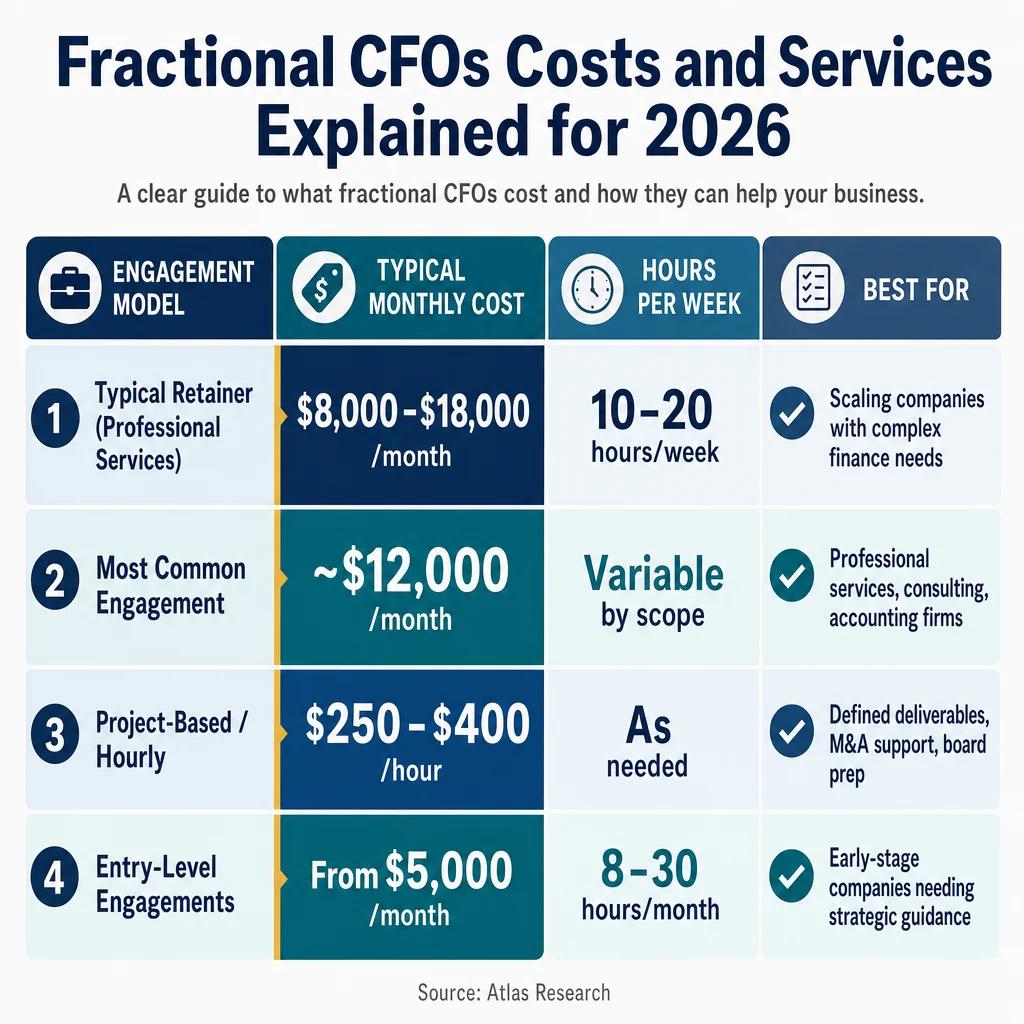
| Engagement Model | Typical Monthly Cost | Hours per Week | Best For |
|---|---|---|---|
| Typical Retainer (Professional Services) | $8,000 - $18,000/month | 10-20 hours/week | Scaling companies with complex finance needs |
| Most Common Engagement | ~$12,000/month | Variable by scope | Professional services, consulting, accounting firms |
| Project-Based / Hourly | $250 - $400/hour | As needed | Defined deliverables, M&A support, board prep |
| Entry-Level Engagements | From $5,000/month | 8-30 hours/month | Early-stage companies needing strategic guidance |
Where to read further
If you want to explore the platform landscape in more detail before committing to a specific engagement model, the platform comparison published by Fractional Jobs breaks down five leading services by model, pricing structure, and ideal use case. For a deeper look at cost drivers and engagement timing including a practitioner perspective on when the investment actually makes sense the 2026 guide from Eightx covers the same ground with a focus on ecommerce, CPG, and SaaS contexts. And if you are evaluating firms specifically, the Shiny breakdown of twelve fractional CFO firms provides detailed profiles with direct links to each organization's service model and client profiles.