



The Quiet Case for Workbooks in a Book-Saturated World
There is a particular kind of reader who has tried everything. They have read the books. They have bookmarked the podcasts. They have downloaded the meditation apps and maybe even completed a course or two. And still, something feels unfinished not because the advice was wrong, but because reading about change is not the same as doing the work of change. For these readers, the self-help workbook occupies a different category entirely: it is not a lecture to absorb but a conversation to participate in.
This distinction matters more than most people realize. Therapists, coaches, and educators have long observed that readers who pair reading with structured workbook exercises tend to report a stronger sense of progress than those who read without any accompanying practice. The broader pattern is consistent: active engagement with material produces different results than passive consumption.
That gap between reading about growth and actually doing it is where author Maura Leigh has built her practice. Her two self-help titles, Officially Untangled: Navigating The Beautiful, Messy Reality of Starting Over and Trust Your Gut: Unlock Inner Wisdom & Self-Trust, are not positioned as quick fixes or motivational pep talks. They are framed, in her own language, as tools for people who are willing to sit with discomfort and do the work.
Who Maura Leigh Is and What She Has Built
Maura Leigh is an author, novelist, and independent publisher whose work sits at the intersection of personal reflection and practical self-help. Her Linktree profile serves as the central hub for her published ebooks, paperbacks, and workbooks, alongside her Vesh line of patent-pending ergonomic hair tools a separate product category that reflects her background as an abstract artist merging industrial design with safety and creativity.
Her self-help catalog is deliberately focused. more than producing a broad catalog of titles across dozens of topics, she has concentrated her publishing on two core themes: navigating major life transitions and rebuilding the internal compass that tells a person what to trust in themselves, their instincts, and their next step. The titles reflect this focus. Officially Untangled takes on the emotional and practical complexity of starting over whether that means a new relationship, a new career chapter, a new city, or a new version of yourself after loss or upheaval. Trust Your Gut works on the quieter, harder problem of inner wisdom: the voice that tells you something is right or wrong before you have enough data to justify it.
What makes her approach notable in a crowded self-help market is the language she uses to describe her own work. On her Linktree profile, she describes Officially Untangled as dealing with "the beautiful, messy reality" of starting over a phrase that acknowledges complexity without dramatizing it. That framing is consistent across her public materials: she does not promise a clean path. She promises an honest one.
What the Research Actually Says About Self-Help Workbooks
The question of whether self-help workbooks actually work is not new, but the evidence base has grown considerably over the past decade. A substantial body of research in clinical psychology supports the use of structured self-help materials including workbooks as effective or adjunctive treatments for mild to moderate anxiety, depression, and low self-worth. The key qualifier is "structured": a workbook that asks a reader to fill in prompts, track behaviors, reflect on patterns, and revisit core concepts over time functions differently from a book that simply describes those concepts.
One of the most consistent findings in the self-help literature is that the therapeutic gains from workbooks are strongly correlated with completion rates. Readers who work through a workbook from start to finish report significantly higher symptom reduction than those who abandon it partway through. This has practical implications: the best self-help workbooks are designed not just with good content but with engagement in mind shorter exercises, clear progression, varied formats, and a sense of momentum.
For anxiety and depression specifically, cognitive behavioral therapy (CBT) workbooks have the strongest evidence base. These workbooks typically guide readers through identifying thought patterns, challenging distorted thinking, and building behavioral habits that support mental health. But the broader self-help category includes workbooks rooted in acceptance and commitment therapy (ACT), mindfulness-based approaches, narrative therapy, and strengths-based frameworks each with a different emphasis and a different kind of work asked of the reader.
The comparison below maps several dimensions that distinguish self-help books from self-help workbooks, based on common structural and functional features.
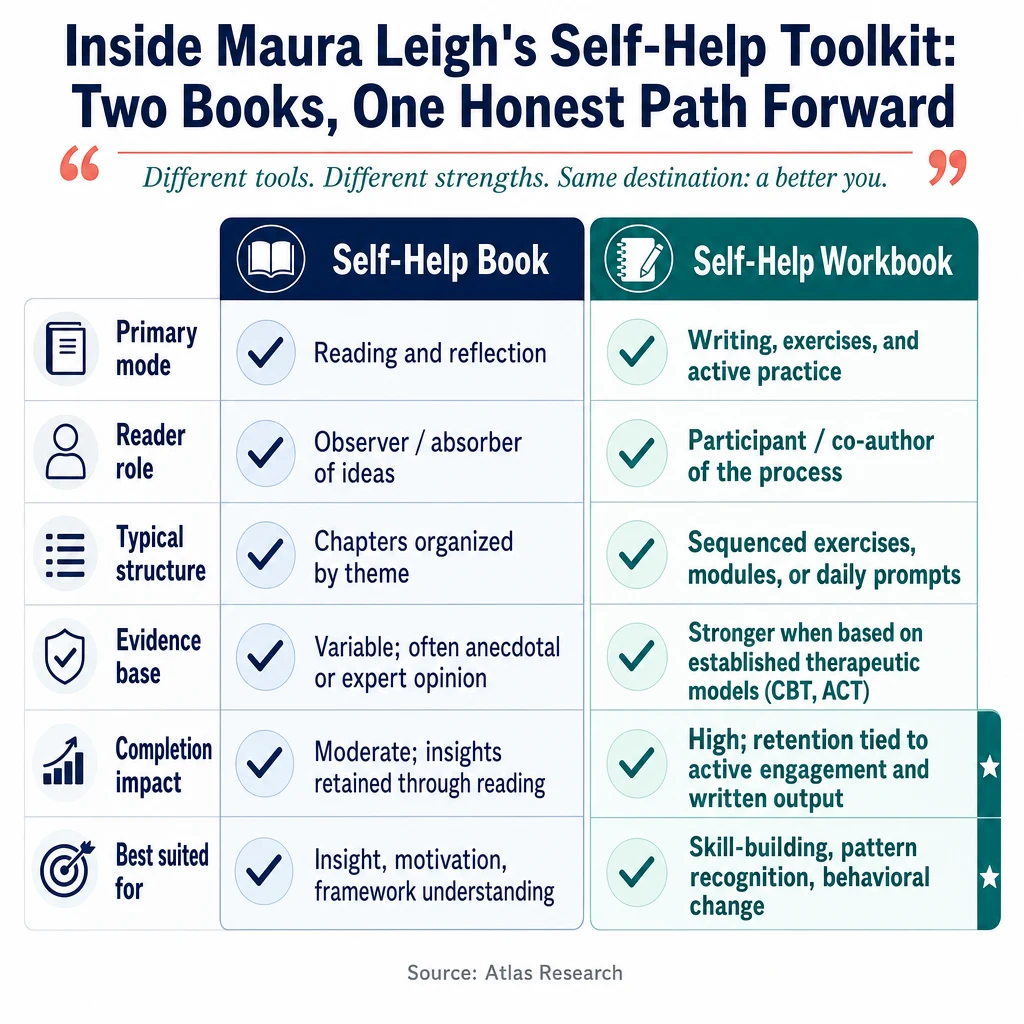
| Dimension | Self-Help Book | Self-Help Workbook |
|---|---|---|
| Primary mode | Reading and reflection | Writing, exercises, and active practice |
| Reader role | Observer / absorber of ideas | Participant / co-author of the process |
| Typical structure | Chapters organized by theme | Sequenced exercises, modules, or daily prompts |
| Evidence base | Variable; often anecdotal or expert opinion | Stronger when based on established therapeutic models (CBT, ACT) |
| Completion impact | Moderate; insights retained through reading | High; retention tied to active engagement and written output |
| Best suited for | Insight, motivation, framework understanding | Skill-building, pattern recognition, behavioral change |
The distinction is not about quality or importance it is about function. A self-help book can change the way you think about a problem. A well-designed self-help workbook can change the way you interact with it, day by day, in your own words.
Why Many Readers Who Complete a Workbook Report Measurable Progress
The statistic surfaces repeatedly in self-help community data: a significant majority of readers who complete a structured self-help workbook report feeling more capable of managing the specific challenge the workbook addressed. The figure varies by study and by population, but the directional finding is consistent enough that it has influenced how therapists and coaches incorporate self-help materials into their practice.
What the statistic does not capture and what matters enormously in practice is the gap between starting and finishing. Workbooks that are too dense, too abstract, or too demanding in any single session tend to be abandoned. This is one reason why independent authors like Maura Leigh, who design their own materials without the infrastructure of a major publisher, often pay close attention to pacing and format. The difference between a workbook that gets finished and one that gets abandoned is often structural, not content-based.
For readers evaluating whether a specific workbook is likely to work for them, several practical indicators matter: the length and complexity of individual exercises, the presence of clear progress markers, the tone of the writing (does it feel like a companion or a textbook?), and whether the workbook is designed to be used independently or alongside a therapist or group. Maura Leigh's two titles available through her Linktree profile are structured as independent-use tools, meaning a reader can work through them at their own pace without needing a facilitator.
How to Choose the Right Self-Help Book for Your Needs
Choosing a self-help book or workbook is a surprisingly personal decision, and the factors that matter depend on where you are in your process. A reader who is in acute distress needs different material than a reader who is in a reflective growth phase. A reader who thrives on structure needs different material than one who responds better to open-ended prompts. The following framework is not a prescription but a map a way of thinking through what you actually need before you buy.
Start with the problem, not the promise. Self-help titles are often marketed with aspirational language "unlock your potential," "reclaim your confidence," "find your path." These promises are not inherently dishonest, but they can obscure whether a book is actually designed to address your specific situation. Before selecting a title, name the problem as specifically as you can. Is it anxiety that surfaces in social situations? A persistent sense of being stuck after a major life change? Difficulty trusting your own judgment in relationships or career decisions? The more specific you can be, the easier it is to find a book that is designed for that problem beyond a general one.
Check the framework. Self-help books are built on different theoretical foundations, and these foundations produce different kinds of advice. A book rooted in cognitive behavioral principles will focus on thought patterns and behavioral experiments. A book rooted in somatic or body-based approaches will focus on physical sensation and nervous system regulation. A book rooted in narrative or storytelling approaches will focus on how you make meaning of your own experience. None of these frameworks is superior in the abstract the right one is the one that resonates with how you actually experience your challenges.
Consider the format. If you know that you do best with structured, daily exercises, a workbook format is likely more effective for you than a traditional book format. If you are looking for insight, perspective, and a new way of understanding your situation, a narrative or essay-style self-help book may serve you better. Many readers benefit from using both in sequence starting with a book to shift their understanding, then moving to a workbook to put that understanding into practice.
Look at the author. Who wrote the book matters, particularly in the self-help category where anyone with a story and a computer can publish. Look for evidence that the author has relevant experience, training, or lived experience that connects to the specific topic. Maura Leigh's titles, for example, are framed around her own experience with starting over and rebuilding self-trust a framing that is honest about the personal nature of the work more than positioning the author as a clinical expert.
Are There Free Self-Help Workbooks Available Online?
Yes and the landscape is wide. Free and low-cost self-help workbooks are available through mental health organizations, university counseling centers, public libraries, and independent authors who release materials at no cost as a way of building an audience or serving a community. The challenge is not finding them. The challenge is evaluating quality.
Some of the most reliable free workbooks come from established mental health organizations. The Centre for Clinical Interventions (CCI) in Western Australia, for example, has published a series of free, evidence-based workbooks on topics including procrastination, perfectionism, low mood, and anxiety. These materials are structured, referenced, and designed for self-directed use. The National Health Service (NHS) in the United Kingdom offers similar resources through its digital mental health platforms. University counseling centers at major institutions often share workbooks on stress management, sleep hygiene, and test anxiety.
The quality of free workbooks varies enormously. A workbook that looks professionally designed may be based on solid therapeutic principles, or it may be a well-formatted but theoretically baseless collection of prompts. The indicators of quality are similar to those for paid workbooks: does the workbook have a clear theoretical foundation? Is it structured with a logical progression? Does it include guidance on how to use the material safely? Is there any indication of who authored it and what their credentials are?
For readers who want a curated, personally authored experience where the voice, structure, and exercises reflect a single author's vision and lived experience independent authors like Maura Leigh offer a different value proposition. The materials are not free, but they come with the coherence and accountability of a single creative perspective. That coherence is not a small thing. When a reader works through a workbook by one author, they are not just absorbing exercises they are entering a relationship with a particular way of seeing the world.
What Maura Leigh's Two Titles Actually Offer
Officially Untangled: Navigating The Beautiful, Messy Reality of Starting Over is the more narrative of the two titles. The language in the title "beautiful, messy reality" signals that the book is not interested in selling a sanitized version of personal growth. Starting over, in Maura Leigh's framing, is not a clean event with a clear before and after. It is an ongoing process with false starts, emotional complexity, and moments where the reader may feel more lost than when they began. The book appears to be designed for readers who have already tried to move forward and found that the process was harder than expected.
Trust Your Gut: Unlock Inner Wisdom & Self-Trust takes on a different but related challenge. The capacity to trust one's own judgment to act on instinct, to listen to internal signals, to distinguish between fear and intuition is a skill that many people in transition are trying to rebuild. This title appears to address the specific difficulty of making decisions when your internal compass has been disrupted by stress, loss, or repeated second-guessing.
Both titles are available as ebooks, paperbacks, and workbooks through Maura Leigh's Linktree profile, which functions as a centralized storefront for her publishing and product lines. The profile also features her Vesh ergonomic hair tools a separate product category that reflects her broader interest in design, safety, and everyday utility alongside a range of self-care and journaling products from third-party brands.
Why This Matters for Readers
The self-help category is large enough that it can feel impersonal. Readers who pick up a book expecting transformation often find themselves in the position of the reader Rilke described in The Notebooks of Malte Laurids Brigge someone who has absorbed many words but has not yet found the one that makes contact with their actual experience. The difference between a self-help book that works and one that does not is often not the quality of the advice but the degree to which the reader feels seen by the author recognized in their specific difficulty, not just in a general category of "people who want to improve."
Maura Leigh's approach, as it appears in her public materials, is built around that specificity. Her titles do not promise to fix everything. They promise to address particular problems starting over, rebuilding self-trust with honesty about the difficulty involved. For readers who have tried generic self-help and found it too broad to be useful, that specificity is itself a form of care.
The broader context for this kind of work is significant. Mental health professionals increasingly recognize that the gap between needing help and accessing it is not only about cost or availability it is also about fit. Many people who could benefit from structured self-help materials do not seek therapy not because they are in denial about their struggles but because they are not sure whether a formal therapeutic setting is right for them. Self-help books and workbooks offer an on-ramp: a way to begin the work at your own pace, in your own space, before or alongside other forms of support.
What This Means for @mauraleigh Author, Novelist, Self-Help Ebooks, Paperbacks, & Workbooks, | Linktree Readers
For readers who discover Maura Leigh through her Linktree profile, the entry point is practical and uncluttered. The profile organizes her work by category ebooks, paperbacks, workbooks, and her Vesh product line making it straightforward to find the specific format that fits your needs. If you are a reader who prefers to hold a physical book, her paperback titles are available. If you prefer to start with an ebook before committing to a purchase, those options are listed as well.
The two self-help titles Officially Untangled and Trust Your Gut are positioned as companion pieces more than standalone reads. A reader working through a major life transition might start with Officially Untangled for the narrative and emotional framework, then move to Trust Your Gut for the practical work of rebuilding decision-making confidence. The progression is logical and reflects a genuine understanding of how personal growth often works: insight first, then practice.
For readers who are not yet sure which title fits their situation, Maura Leigh's profile includes a direct invitation to ask her a small but meaningful gesture that acknowledges the reader's uncertainty and offers a human response beyond a marketing funnel.
Where to Read Further
Readers who want to explore the full range of Maura Leigh's self-help catalog can start at her Linktree profile, where both titles are available in multiple formats. For readers interested in the broader landscape of self-help research including the evidence base for workbooks in clinical and community settings Goodreads offers a substantial community-reviewed catalog of self-help titles across every major framework, with reader reviews that provide practical context beyond what any single author or publisher can offer.
For readers drawn to the literary and philosophical dimensions of personal growth writing, the broader tradition that Maura Leigh's work enters is worth exploring. The Notebooks of Malte Laurids Brigge by Rainer Maria Rilke, published in 1910, is a foundational text in the tradition of using writing as a tool for confronting uncertainty, change, and the self. Though not a self-help book in the contemporary sense, it is a touchstone for writers and readers who believe that honest, difficult writing about personal experience can itself be a form of practice.
Key Takeaways
Self-help books and self-help workbooks serve different but complementary functions. Books provide insight and framework; workbooks provide practice and structure. Readers who use both in combination tend to report stronger outcomes than those who rely on either alone.
When choosing a self-help title, specificity matters more than popularity. The best book for your needs is the one that is designed for your actual problem not a general aspiration and written in a voice that makes you feel recognized more than generalized.
Free self-help workbooks are available online through mental health organizations and university counseling centers, but quality varies. Independent authors like Maura Leigh offer a different value proposition: a coherent, personally authored perspective that is designed for independent use and grounded in specific lived experience.
Maura Leigh's two self-help titles Officially Untangled and Trust Your Gut are available through her Linktree profile in ebook, paperback, and workbook formats, offering readers multiple entry points into her approach to personal growth.