


There is a quiet frustration running through the remodeling industry right now. Business owners describe the same scene: their phones ring, their inbox fills up, and yet the leads coming through the door are not the clients they built their reputation for serving. They want three bids. They haggle over price. They're gone by Tuesday.
Meanwhile, the homeowners who are ready to invest $80,000, $100,000, or more in their kitchen or whole-home remodel the clients who will refer their neighbors, who trust the process, who make the work worth doing those leads seem to be going somewhere else.
The instinct is to spend more on Google Ads, to rank higher, to get more eyes on the business. But as hello.bz's remodeling marketing framework frames it: that's not a budget problem. It's a targeting problem.
76% of Mobile Remodeling Searches Convert But Are They the Right Ones?
The data on digital behavior in the home services market tells a striking story. According to Leads4Build's 2025 guide for home renovation businesses, over 55% of homeowners begin their search online, and 78% of mobile searches for remodeling services convert to purchase within 24 hours. Those are conversion rates most industries would celebrate.
But here is what that statistic does not tell you: which searches those 78% are making, and which contractors are showing up when they make them.
The same source notes that the global home services market is expected to grow 18.91% per year through 2026. That growth is real. The question is who captures it and whether it flows toward the remodeler who learned to appear in front of the right searches, or the one still bidding on the same generic keywords as every other contractor in town.
The Keyword Gotcha: Why "Kitchen Remodeler" Attracts the Wrong Clients
According to hello.bz's Google Ads analysis for remodelers, most campaigns are built around the same keywords every contractor bids on: "kitchen remodeler," "bathroom renovation," "home addition." These keywords have volume. They also attract the most price-sensitive segment of the market homeowners who are comparison shopping on a Saturday, collecting three bids before they call anyone back.
"They're not wrong for shopping around," the source notes. "But they're not your ideal client either."
Meanwhile, homeowners ready to invest $50,000, $80,000, $100,000 or more in their kitchen are searching differently. They are looking for portfolios. They are reading process explanations. They are checking design credentials. They are looking for trust signals before they ever pick up the phone.
The targeting gap is not a spending problem. It is a messaging and keyword strategy problem.
How High-Ticket Homeowners Search Differently
Research from Comrade Web's 2026 home remodeling marketing strategies reinforces this pattern. The source notes that 91.5% of homeowners pick one of the remodelers they see on the first page of Google which has roughly ten results. The battle for that first-page position matters, but the keywords you rank for determine which 91.5% you attract.
For high-ticket clients, the search language shifts. They are not just looking for "kitchen remodeler." They are looking for "luxury kitchen renovation contractor," "whole-home remodel portfolio," "design-build firm near me," or "premium bathroom renovation process." These searches have lower volume but dramatically higher intent and far less competition.
The Math That Changes Everything: $2.4 Million or Burnout
This is where the strategic case becomes financial. Hello.bz's remodeling marketing framework lays out a comparison that most contractors find counterintuitive at first:
- Three high-ticket projects per month at $80,000 or more equals $2.4 million or more in annual revenue.
- Twelve medium-price jobs that constantly need attention equals a full schedule with thin margins and exhausting management.
"You don't need more volume," the source states. "You need a system that attracts clients at the top of the market."
This is not a rejection of growth. It is a reframe of what growth actually looks like for a remodeling business. More leads is not the answer. The right leads is the answer.
The ROI Difference Between High-Ticket and Discount Clients
A new customer who comes in through a discount offer costs money. The time spent estimating, the overhead of a sales process, the materials and labor margins they erode when a client who arrived via discount is also client who requests multiple revisions, compares every line item, and shops your bid to two other contractors.
By contrast, a customer who finds you because you are the obvious choice for luxury remodels is worth tens of thousands over the lifetime of that relationship. The referrals that follow neighbors who saw the work, friends who loved the process compound that value.
According to Home Remodeler SEO's approach to digital marketing, any business can thrive with a sound marketing plan and SEO strategy in place but the strategy has to be built for the client you want, not the client you happen to get.
Job Type Changes Everything: Why Segmentation Matters
One of the clearest distinctions in effective high-ticket remodeling marketing is segmentation by project type and budget tier. Hello.bz's framework makes this explicit: "A $6,000 bathroom refresh and a $90,000 whole-home remodel need different messaging, different targeting, and different landing pages."
This is a structural shift from how most contractors approach their marketing. They build one website, run one set of ads, and hope that whoever calls is the right fit. When the fit is wrong too often, the instinct is to spend more to get more calls which just multiplies the problem.
Segmentation means building campaigns that speak directly to the project scope the client is considering. A homeowner researching a whole-home remodel is in a different decision stage than one looking for a bathroom update. They have different questions. They need different trust signals. They respond to different language.
Building Campaigns for the Consideration Cycle
Remodeling has the longest consideration cycle in home improvement, according to hello.bz's analysis. Homeowners researching kitchen and bath projects may spend months comparing firms before they contact anyone. They are reading portfolio pages, watching process videos, checking reviews, and gathering estimates all before the first phone call.
This means the marketing that reaches them has to be present throughout that decision process. Content that answers comparison questions early "how do I choose a design-build firm?" "what should I expect during a whole-home remodel?" "how do I know if a contractor is right for a luxury renovation?" keeps your brand present when the decision is made.
Trust Before the First Call: What High-Ticket Clients Need to See
Homeowners selecting a remodeler are choosing someone to be inside their home for weeks. That is not a transaction. It is a relationship that requires significant trust before it begins. Hello.bz's remodeling marketing guidance identifies three key trust signals that reduce sales friction before contact:
- Portfolio depth not just completed projects, but stories of how those projects unfolded, the decisions made, the results achieved.
- Review recency recent testimonials from clients who worked with you at your current quality level, not five years ago when your process was different.
- Transparent process descriptions how does a project actually start? What happens between the first call and the signed contract? What do you do when something unexpected comes up?
For high-ticket clients, these signals are not nice-to-have. They are the minimum threshold for consideration. Without them, you do not make the shortlist. With them, you enter the decision process with credibility already established.
What This Means for Remodelers: Where the Strategy Shifts
For the remodeling business owner reading this, the practical shift is not about spending more. It is about spending differently and thinking differently about what success looks like.
Instead of asking "how do I get more leads?", the question becomes "how do I get in front of the homeowners who are already researching a $80k+ project and looking for exactly what I offer?"
That question leads somewhere different. It leads to keyword research that targets high-intent searches instead of high-volume ones. It leads to landing pages that speak directly to the project scope a client is considering. It leads to content that answers the questions affluent homeowners ask before they call and answers them in a way that builds trust.
It also leads to a more sustainable business rhythm. Fewer projects. Better clients. More revenue from work you actually enjoy.
Comparing the Two Approaches
For a clearer picture of how high-ticket targeting differs from generic lead generation, consider the following comparison:
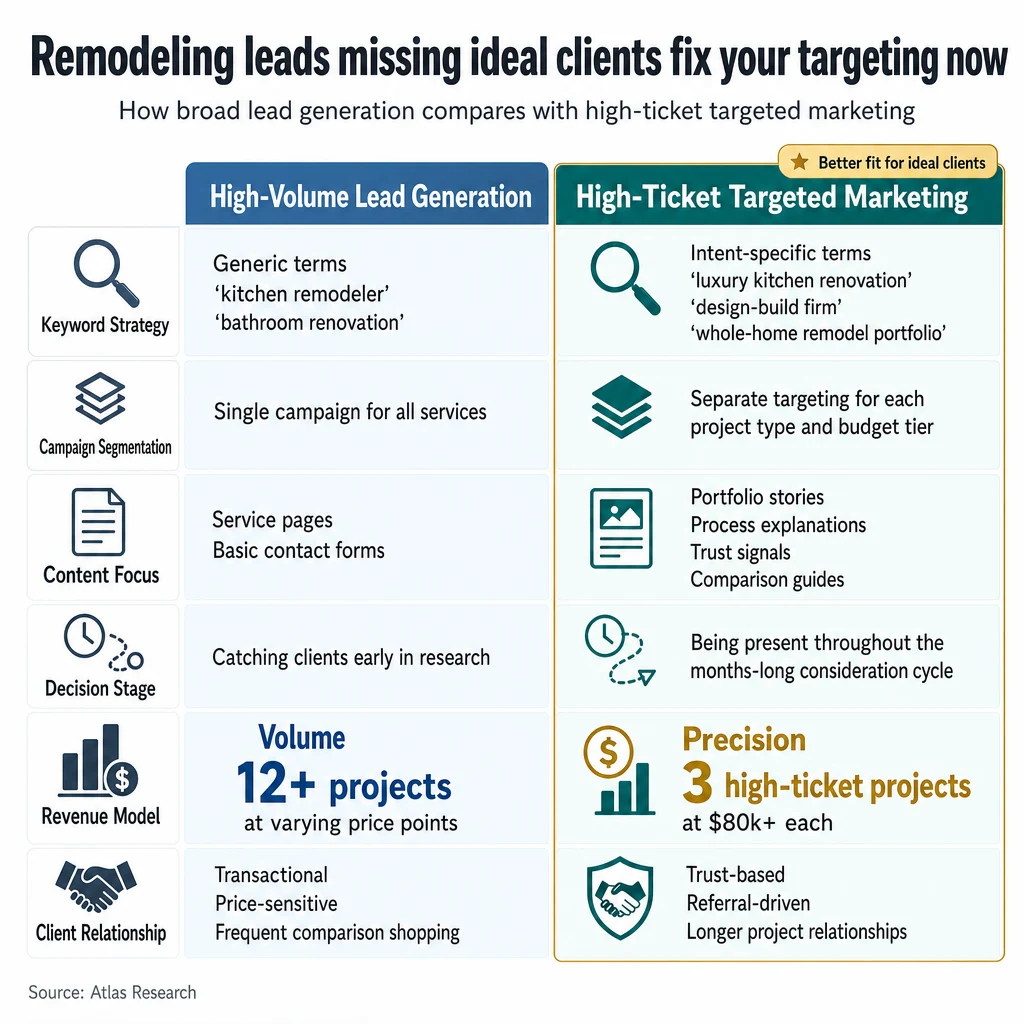
| Factor | High-Volume Lead Generation | High-Ticket Targeted Marketing |
|---|---|---|
| Keyword Strategy | Generic terms: "kitchen remodeler," "bathroom renovation" | Intent-specific: "luxury kitchen renovation," "design-build firm," "whole-home remodel portfolio" |
| Campaign Segmentation | Single campaign for all services | Separate targeting for each project type and budget tier |
| Content Focus | Service pages, basic contact forms | Portfolio stories, process explanations, trust signals, comparison guides |
| Decision Stage | Catching clients early in research | Being present throughout the months-long consideration cycle |
| Revenue Model | Volume: 12+ projects at varying price points | Precision: 3 high-ticket projects at $80k+ each |
| Client Relationship | Transactional, price-sensitive, frequent comparison shopping | Trust-based, referral-driven, longer project relationships |
The Local Visibility Factor
High-ticket remodeling clients are often working with a defined geographic area they want a contractor who knows their neighborhood, understands local architecture, and can point to nearby completed projects. Comrade Web's 2026 marketing strategies emphasize that local SEO fundamentals remain critical: a maintained Google Business Profile, consistent city keywords, and matching business information across directories.
For high-ticket targeting, local visibility takes on a different meaning. It is not just about appearing in searches for "kitchen remodeler in [city]." It is about appearing in searches for "luxury home remodeler near [affluent neighborhood or city]," and having the portfolio to back up that positioning when the client does their due diligence.
Where to Read Further
For remodelers looking to move from volume-based lead generation toward a high-ticket targeting strategy, several of the sources cited here offer deeper frameworks and practical guidance.
Hello.bz's remodeling marketing overview presents a structured approach to revenue-focused marketing for home service businesses, with specific emphasis on the segmentation and trust-building that supports high-ticket client attraction.
The Google Ads analysis for remodelers goes deeper into why generic keyword campaigns attract the wrong clients and what targeting adjustments shift the lead quality without increasing spend.
For a broader view of the digital marketing landscape, Leads4Build's 2025 remodeling marketing guide covers the full spectrum of digital channels, business stages, and contractor types useful context for understanding where high-ticket targeting fits within a comprehensive strategy.
Comrade Web's 13 strategies for 2026 provides actionable tactics across SEO, content, and digital presence that can be applied to a high-ticket positioning strategy.
Finally, Home Remodeler SEO's approach to contractor marketing reinforces the importance of a sound SEO foundation built specifically for the remodeling industry emphasizing that the right visibility, not just more visibility, drives the results that matter.
Moving Forward
The remodeling market is not standing still. Every month that passes with a marketing strategy aimed at the wrong clients is a month of lost revenue and missed relationships. The homeowners ready to invest $80k or more in their next project are searching for someone like you. The question is whether they can find you and whether, when they do, your marketing gives them the signals they need to pick up the phone.
That is not a budget problem. It is a targeting problem and it has a solution.