


What Is Colossus 2? The Data Center That Redefined AI Scale
When SpaceXAI launched its Colossus 2 facility in Memphis, Tennessee, it didn't simply build another data center it erected a statement about the future of artificial intelligence compute. According to Epoch AI's technical directory, Colossus 2 is an operational AI data center with AI chips owned by SpaceXAI and used by Anthropic, Cursor, and SpaceXAI itself. The facility hosts an estimated 1,112,000 H100-equivalents of AI compute, supported by 946 megawatts of IT power at a capital cost of $35.8 billion.
The scale is difficult to comprehend. To power the site quickly, xAI installed natural gas turbines just across the state border in Mississippi, possibly to secure faster approval for their operation, according to Epoch AI's analysis of cooling equipment power models and satellite imagery. Training of newer Grok models shifted primarily to Colossus 2 and related sites, making this facility central to SpaceXAI's chatbot development ambitions.
By Q1 2027, SpaceXAI projects Colossus 2 to rise to 1,824,000 H100-equivalent AI compute, 1,531 MW of IT power, and a total cost of $58 billion. That trajectory from 946 MW to 1,531 MW in roughly a year represents growth that no conventional data center project has attempted.
Location: A Twin-State Operation Built on Speed
The choice of Memphis, Tennessee as Colossus 2's home was not accidental. According to Wikipedia's overview of the Colossus data center project, a second major facility called Colossus 2 (also referred to as Macrohard) was developed beginning in 2025 in the Whitehaven area of Memphis, with associated power generation across the state line in Southaven, Mississippi. The data center sits just north of the Tennessee state line, in Memphis's Whitehaven neighborhood; the main power site sits across the border, in Southaven.
This arrangement computing in Tennessee, power generation in Mississippi reflects a deliberate strategy to navigate regulatory environments on both sides of the border. The gas burns in Mississippi; the electricity crosses to Tennessee. The grid couldn't deliver enough electricity on SpaceXAI's timeline, so the company brought generation onsite with portable gas turbines rather than waiting for a conventional power plant or utility upgrade.
Additional nearby buildings (sometimes called Minihard and Macrohardrr or Colossus 3) expanded the cluster. As of mid-2026, the combined sites provided on the order of 1 gigawatt of AI compute capacity.
The Power Question: How Much Energy Does Colossus 2 Actually Use?
The numbers are staggering. Epoch AI's technical analysis documents that Colossus 2 currently operates at 946 MW of IT power, with projections reaching 1,531 MW by Q1 2027. The facility uses Nvidia B200 and Nvidia B300 chips, with air-cooled chillers and air-cooled condensers handling thermal management.
According to the technical breakdown, 217 air-cooled chiller units and 144 air-cooled condensers provide 412.3 MW of cooling capacity. The timeline of IT power and AI compute capacity is based on satellite imagery, cooling equipment power modeling, company disclosures, and drone imagery. Satellite data shows land clearing began next to the existing building on February 28, 2025, and a battery facility was connected by September 8, 2025, with 121 air-cooled chillers installed that could support 200 MW.
By July 2026, the Mississippi power plant had a capacity of about 1,775 megawatts, rivaling the state's largest power plant, according to Scientific American's investigative feature. The facility counted 69 temporary gas turbines at the site more than double the number the company had previously acknowledged.
World's Largest AI Data Center: Is Colossus 2 Unmatched?
The evidence supports the claim. Gate News reported that SpaceXAI's Colossus 2 became the world's largest AI data center at 946 MW. The facility's 1,112,000 H100-equivalents of AI compute represents an unprecedented concentration of training horsepower.
The original Colossus 1 was built in a former Electrolux factory in South Memphis, with construction of approximately 100,000 Nvidia H100 GPUs completed in 122 days. That system went live in mid-to-late 2024, with capacity later expanded. Epoch AI estimates the site's chips now include about 150,000 H100s, 50,000 H200s, and 30,000 B200s.
What makes Colossus 2 distinctive is not just its current scale but its growth trajectory. The facility's projected expansion to 1,824,000 H100-equivalents and 1,531 MW by Q1 2027 would represent nearly 65% growth in compute and 62% growth in power consumption within a single year.
Mississippi Expansion: Gun Range and Spam Join the Cluster
SpaceXAI is not standing still. Data Center Dynamics reported that CEO Elon Musk has said he's expanding the company's Colossus 2 data center across two additional sites in Southaven, Mississippi. The sites, dubbed Gun Range and Spam in reference to the location, will both be operational by end of the year, according to Musk's claims.
This expansion represents SpaceXAI's continued commitment to the Memphis-Shelby County-Southaven corridor as its primary AI infrastructure hub. The two new Mississippi campuses will add to an already dense cluster that includes the original Colossus 1 facility, Colossus 2, Minihard, and Macrohardrr.
The expansion comes at a time when the company is also deepening relationships with major AI labs. In May 2026, Anthropic agreed to rent essentially all compute capacity at Colossus 1. On June 5, 2026, Google agreed to rent access to approximately 110,000 GPUs from SpaceXAI beginning October 2026 through June 2029 for $920 million per month, though the specific facility was not publicly identified.
The Permitting Battle: What the Backlash Reveals
Building at this scale attracts scrutiny. Scientific American documented how SpaceXAI's Southaven power plant feeds one of its data centers across the Tennessee state line in Memphis, and how the operation has drawn significant opposition from local communities and regulators.
Taylor Logsdon was 20 when she and her high school sweetheart moved up their wedding so she could buy a $79,000 house in Colonial Hills, a mixed-income neighborhood of winding, tree-lined streets in Southaven, Mississippi. About 11 years later, that house sits near what could become one of the largest power plants in the state, a thicket of gas turbines assembled to feed SpaceXAI's artificial intelligence ambitions.
Beyond Logsdon's neighborhood, the power plant is mostly hidden. Along the road, black privacy fabric wraps the tall chain-link fence surrounding the Southaven site. Past a thin line of trees, metal stacks rise above the fence, and exhaust shimmers in the heat. A $7-million sound wall does little to muffle the noise, which drills through the walls of nearby homes: a constant drone like a plane taking off and never leaving.
The NAACP sued in April, calling the operation an unpermitted power plant. By July, Mississippi regulators counted 69 temporary gas turbines at the site more than double the number the company had previously acknowledged. The turbines were installed under Mississippi's determination that portable equipment could run for up to a year without air permits.
Why This Matters for SpaceXAI Readers
The Colossus 2 story illustrates a fundamental tension in the AI industry: the hunger for compute versus the realities of power infrastructure, regulatory frameworks, and community impact. For readers evaluating AI infrastructure investments, partnership opportunities, or the broader trajectory of AI compute capacity, this case offers a real-world laboratory of challenges and solutions.
SpaceXAI's willingness to build across state lines, deploy temporary generation assets, and pursue rapid expansion has enabled it to achieve scale faster than competitors relying on conventional utility partnerships. However, this approach has surfaced legitimate questions about permitting timelines, environmental review, and community engagement that other projects may need to navigate.
The entry of major customers like Anthropic and Google validates the site's strategic importance. These relationships suggest that Colossus 2 is not merely a SpaceXAI internal resource but a shared infrastructure platform for the broader AI ecosystem a model that could shape how future AI compute clusters are developed and financed.
A Timeline of Colossus 2's Buildout
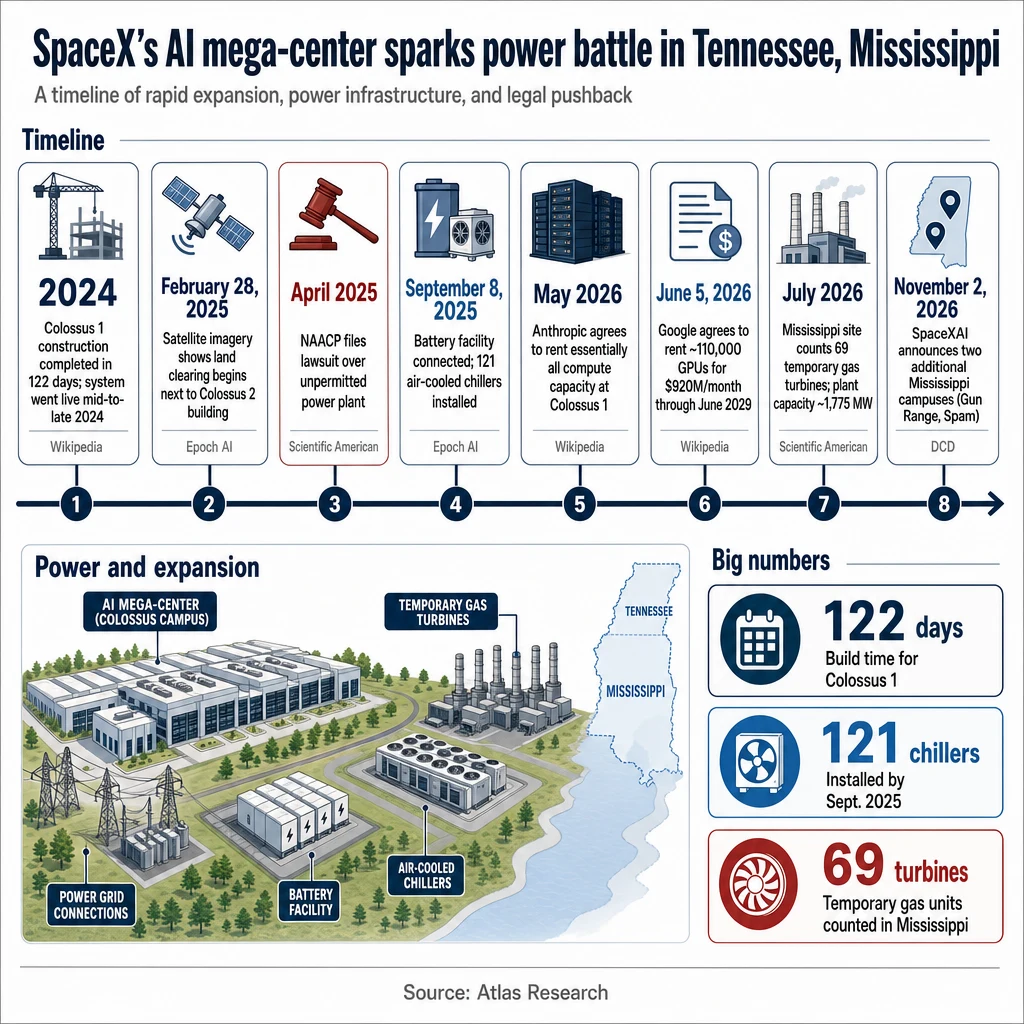
| Date | Milestone | Source |
|---|---|---|
| 2024 | Colossus 1 construction completed in 122 days; system went live mid-to-late 2024 | Wikipedia |
| February 28, 2025 | Satellite imagery shows land clearing begins next to Colossus 2 building | Epoch AI |
| April 2025 | NAACP files lawsuit over unpermitted power plant | Scientific American |
| September 8, 2025 | Battery facility connected; 121 air-cooled chillers installed | Epoch AI |
| May 2026 | Anthropic agrees to rent essentially all compute capacity at Colossus 1 | Wikipedia |
| June 5, 2026 | Google agrees to rent ~110,000 GPUs for $920M/month through June 2029 | Wikipedia |
| July 2026 | Mississippi site counts 69 temporary gas turbines; plant capacity ~1,775 MW | Scientific American |
| November 2, 2026 | SpaceXAI announces two additional Mississippi campuses (Gun Range, Spam) | DCD |
| End of 2026 (projected) | Gun Range and Spam sites expected to be operational | DCD |
| Q1 2027 (projected) | Colossus 2 to reach 1,824k H100e compute, 1,531 MW IT power, $58B cost | Epoch AI |
What to Watch Next
The Colossus 2 story is still being written. The operational status of the Gun Range and Spam campuses by year-end 2026 will be a key milestone to track. Meanwhile, the NAACP lawsuit and any regulatory decisions from Mississippi's environmental authorities will test whether SpaceXAI's twin-state model can survive legal scrutiny or whether it will require adjustments to permitting approaches.
The Google agreement, which begins in October 2026 and runs through June 2029, represents a three-year commitment that suggests major AI labs view SpaceXAI's infrastructure as a long-term strategic asset rather than a temporary workaround. Monitoring how that relationship develops and whether additional enterprise or lab customers sign similar agreements will illuminate the commercial viability of hyperscale AI compute clusters.
Where to Read Further
- Data Center Dynamics: SpaceXAI launching two additional data center campuses in Mississippi Original reporting on the Gun Range and Spam expansion announcement
- Epoch AI: Colossus 2 technical directory Detailed specifications, power modeling, and satellite imagery analysis
- Scientific American: SpaceXAI's Colossus data center is fueling a massive backlash Ground-level reporting on community impact and permitting challenges
- Wikipedia: Colossus (data center) Comprehensive overview of the full project timeline and structure