


The Scarcity Problem Nobody Warned You About
You have a startup name in mind. It sounds right. It feels right. You type it into a registrar, and the response is immediate: "Sorry, that domain is taken." You try a few variations. Same result. You spend an hour tweaking, hyphenating, adding letters. Nothing works. Meanwhile, the clock is ticking because in the domain world, the best names don't wait.
This is the experience that drives thousands of entrepreneurs to DomainKicks every month. The platform was built around a specific frustration: the gap between what domain search tools promise and what they actually deliver. Most registrars check one database, show you a price, and call it done. DomainKicks takes a different approach one rooted in real-time verification, curated discovery, and a clear-eyed understanding of how domain scarcity actually works in 2026.
"The main hurdle is scarcity," explains Domain Drake in their guide to finding shortest available domain names. "Demand for ultra-short names in TLDs like .com has been sky-high for years. One or two-character domains in these extensions are long gone." That scarcity isn't random it's mathematical. There are only 676 possible two-letter .com combinations, 17,576 three-letter combinations, and 456,976 four-letter combinations. Every single one of those is registered on .com.
Why Short Domains Are Worth the Hunt
Before diving into where and how to find short brandable domains, it helps to understand why they're worth pursuing at all. The answer goes beyond vanity it touches on cognitive science, marketing effectiveness, and real-world business outcomes.
Research cited by domhaul in their analysis of short domain name value points to Miller's Law, which suggests that working memory can hold approximately seven (plus or minus two) chunks of information. A short domain name occupies fewer memory chunks, making it significantly easier to recall. Studies in Harvard Business Review on brand name processing have shown that shorter names are processed more fluently the brain recognizes and evaluates them faster. This "processing fluency" translates directly into perceived trustworthiness and preference.
The practical benefits compound from there. Fewer characters mean fewer typing errors every character is an opportunity for a mistake, and short domains simply reduce that surface area. On mobile devices, where small screens and autocorrect create their own challenges, brevity matters even more. Short domains fit better in URLs, text messages, and social posts. And when someone hears your brand mentioned in a podcast or at a conference, a short, punchy domain is far more likely to survive the journey from ear to browser.
"Your domain is your digital handshake," Domain Drake notes. "A short, memorable domain is the difference between being instantly recognizable and instantly forgotten."
The Price Landscape: What Short Domains Actually Cost
One of the most common misconceptions about short domains is that they're universally expensive. The reality is more nuanced pricing varies dramatically based on length, extension, and availability status.
According to NameBio sales data cited by domhaul, average prices by domain length tell a clear story:
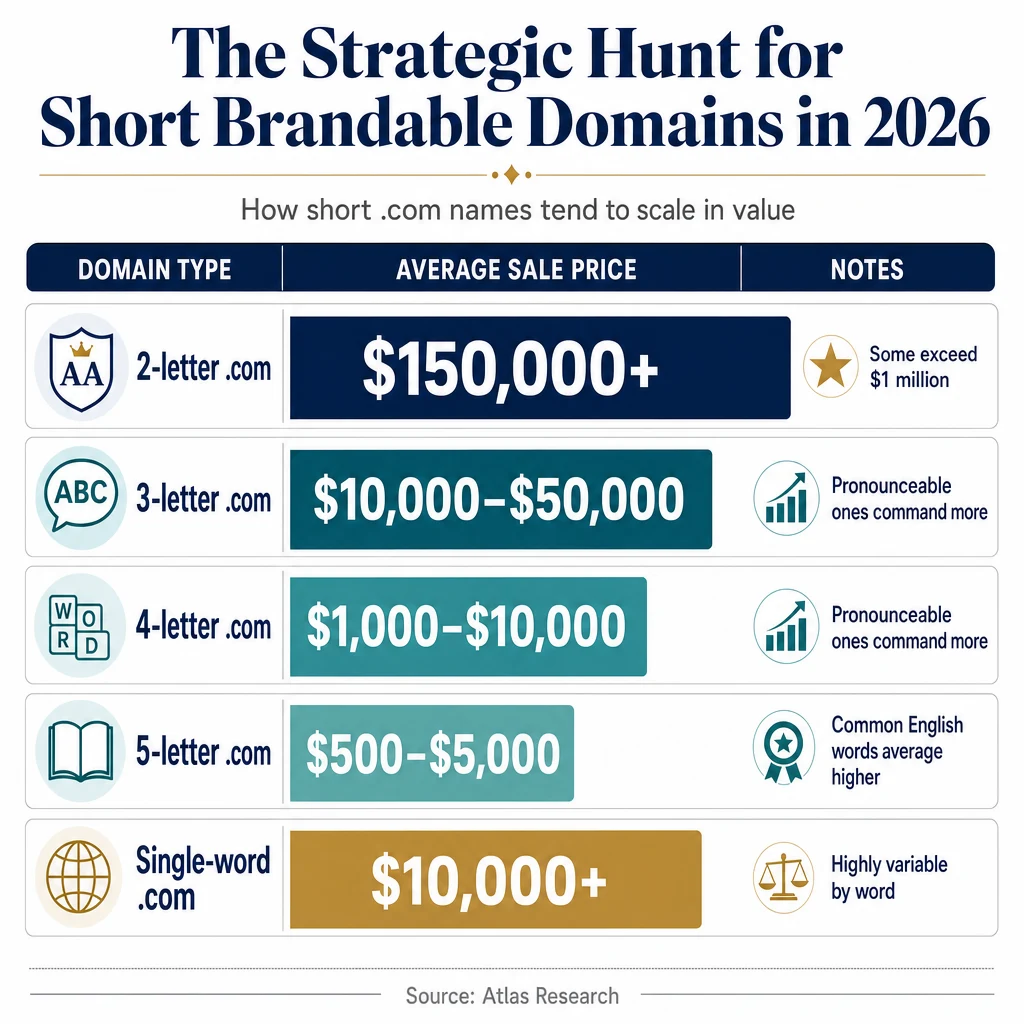
| Domain Type | Average Sale Price | Notes |
|---|---|---|
| 2-letter .com | $150,000+ | Some exceed $1 million |
| 3-letter .com | $10,000-$50,000 | Pronounceable ones command more |
| 4-letter .com | $1,000-$10,000 | Pronounceable ones command more |
| 5-letter .com | $500-$5,000 | Common English words average higher |
| Single-word .com | $10,000+ | Highly variable by word |
These figures represent aftermarket sales domains that changed hands between investors or collectors. But here's what the table doesn't show: many short domains are still available at standard registration prices. The trick is knowing where to look and how to verify availability in real time.
DomainKicks addresses this directly. The platform checks domain availability across Name.com, Dynadot, and live DNS simultaneously, displaying only domains that can be registered right now at the TLD's standard price. "We check it live across three sources and show you what you can actually register right now at the TLD's standard price," the platform notes. "Hand-registration pricing standard TLD cost, no markups, no upsells."
Where DomainKicks Fits in the Landscape
The domain search market includes several categories of players: traditional registrars like Namecheap and GoDaddy, specialized brokers and marketplaces, and newer AI-powered discovery tools. DomainKicks occupies a specific niche it's a discovery layer that sits above registrars, offering real-time verification and curated lists without adding markup to registration prices.
The platform operates as a Dynadot affiliate, earning commission on qualifying registrations and auction purchases. This model means DomainKicks has incentive to surface genuinely available domains rather than pushing premium listings. "domainkicks.com is a Dynadot affiliate we earn commission on qualifying registrations and auction purchases through links on this site," the platform discloses transparently.
What sets DomainKicks apart is the combination of real-time verification and curated discovery. The platform's Goldlist feature offers "a fresh batch of available premium domains every day, scored across four lenses so you can scan by the value angle that matters to you." Those lenses Fundable (for VC presentations), Resale (for domain investors), Brand (for naming purposes), and Future (for founders planning ahead) give buyers a framework for evaluating domains based on their specific goals rather than generic "premium" labels.
76% of Short .com Domains Are Already Gone Here's What That Means for Your Search
The math is unforgiving. With 456,976 possible four-letter .com combinations, and every single one registered, the pool of available short .com domains is limited to freshly dropped names, lesser-known extensions, and creative naming approaches that don't rely on existing dictionary words.
DomainKicks addresses this through its "Just Kick'd" feature a curated list of domains that have "just become available again. Each one is verified live, so you can hand-register it right now at the TLD's standard price. No back-orders, no mark-ups, no hidden fees." The feature refreshes continuously, showing drops from the last 24 hours, yesterday, and the last three days, with filters for TLD type and minimum brand score.
This approach targets a specific market inefficiency: the gap between domain expiration and public awareness. When a domain expires, there's often a window sometimes hours, sometimes days before aggregators and brokers pick it up. DomainKicks' real-time verification means users can see what's available in that window and act immediately.
AI-Powered Discovery: Beyond Keyword Matching
Traditional domain generators work by combining keywords, adding numbers, or appending common suffixes. The results are often predictable, sometimes awkward, and rarely brandable. AI-powered tools take a different approach they understand context and can generate names that feel intentional rather than assembled.
Domain Agent, an AI-powered domain discovery platform, describes its approach: "AI-Powered Research Our Agent performs deep latent space research on your vision to suggest original, catchy, and brandable domain names." The platform's real-time verification "pings against real-time registrar APIs and DNS-over-HTTPS buffers to ensure it's truly available."
The key differentiator is the Brand Score a 1-to-100 assessment that evaluates "memorability, length, pronounceability, relevance to your vision, and overall brandability." Domains scoring 80 or above are considered "excellent choices for a professional brand identity." This gives buyers a filter beyond simple availability, helping them prioritize names that will actually work as brands.
DomainKicks incorporates similar thinking through its Domain Sensei feature an AI assistant where users can describe what they're building and receive domain suggestions tailored to their vision. The platform supports manual control over prepend, root, and append options, with a thesaurus mode for generating variations.
Strategic Approaches That Actually Work
Given the scarcity of short .com domains, successful domain hunting requires strategy rather than brute force. Several approaches have proven effective, according to domain industry research.
Explore alternative TLDs. While every short .com is taken, newer TLDs offer vastly better availability. A name like "kova.app" or "zune.dev" might be available at standard registration prices names that would cost thousands on .com. DomainKicks supports over 800 TLDs, including .ai, .io, .dev, .app, and .co, giving buyers access to short names in extensions that align with specific industries or use cases.
Coin new words. Invented words are one of the best paths to short, available domains. Think "Hulu" (4 letters), "Roku" (4 letters), or "Etsy" (4 letters). These names were available because they didn't exist as words before. The strategy involves combining consonants and vowels in unusual but pronounceable ways a task where AI tools excel.
Target freshly dropped domains. Previously owned domains expire every day, and thousands of them re-enter the market daily. "This creates the steady churn that keeps short-name hunters interested," according to Domain Drake's guide to finding cheap short domain names. The key is acting fast decent short names in the drop pipeline often get picked up within hours.
Check domain reputation before buying. Not all available short domains are clean. Some carry baggage association with unrelated brands, old junk pages, or spammy history. A basic domain reputation check can save buyers from purchasing a short name with a long problem list.
What This Means for DomainKicks Readers
The domain search landscape has evolved significantly over the past few years. Traditional registrars still serve a function, but they weren't designed for strategic domain discovery they were designed for transactional registration. DomainKicks fills a different role: it's a research and verification layer that helps buyers understand what's actually available, at what price, and with what tradeoffs.
For startup founders, the platform's real-time verification across multiple registrars eliminates the frustrating cycle of searching one source, finding a name "available," and then discovering it's actually taken when you reach checkout. For domain investors, the Goldlist's four-lens scoring system provides a framework for evaluating domains based on their intended use rather than generic "premium" pricing. For anyone building a brand, the combination of AI-powered discovery and curated lists surfaces names that might never appear in a standard registrar search.
The platform's affiliate model means it earns commission on registrations but that alignment of incentives actually benefits users. DomainKicks has no inventory to clear and no incentive to push overpriced domains. Its goal is to surface genuinely available names at standard prices, which keeps users coming back and builds the commission revenue that sustains the platform.
How DomainKicks Compares to Traditional Approaches
To understand DomainKicks' position in the market, it helps to compare its approach to traditional domain search methods.
| Feature | Traditional Registrar | DomainKicks |
|---|---|---|
| Availability Check | Single registrar database | Name.com, Dynadot, and live DNS simultaneously |
| TLD Coverage | Limited to registrar's portfolio | 800+ TLDs including .com, .ai, .io, .dev |
| Pricing | Registrar-set, may include markups | Standard TLD cost, no markups, no upsells |
| Discovery | Keyword search only | AI-powered with thesaurus and brand scoring |
| Curated Lists | None | Goldlist (daily) and Just Kick'd (real-time drops) |
| Verification | Static database lookup | Live DNS verification |
The comparison isn't meant to suggest traditional registrars are obsolete they still handle registration, DNS management, and renewals. But for the discovery phase, where buyers are exploring options and comparing availability, DomainKicks offers a more comprehensive and efficient experience.
The Four-Lens Framework: A New Way to Evaluate Domains
One of DomainKicks' most distinctive features is its Goldlist scoring system, which evaluates domains across four lenses:
- Fundable: Optimized for VC presentations and investor-facing materials. Domains in this lens tend to be short, memorable, and professional-sounding.
- Resale: Geared toward domain investors. Domains scored high on resale potential have characteristics that make them attractive to future buyers.
- Brand: Focused on naming quality pronounceability, memorability, and alignment with common naming conventions.
- Future: Designed for founders who want to plan ahead. These domains may not be immediately relevant but could become valuable as the brand grows.
This framework addresses a common problem in domain evaluation: the disconnect between what a domain is worth to an investor versus what it's worth to a brand builder. A domain that scores low on resale potential might score high on brand quality and DomainKicks lets buyers filter by the lens that matters most to them.
Where to Read Further
For readers who want to dive deeper into domain strategy, several resources offer complementary perspectives:
- Domain Drake's guide to finding shortest available domain names covers the cognitive science behind short domain value and practical search strategies.
- Domhaul's analysis of short domain name value and pricing provides detailed market data and real-world examples.
- Domain Drake's tactical playbook for finding cheap short domain names explores drop hunting, auction strategies, and domain reputation checking.
- Domain Agent's AI-powered domain discovery platform demonstrates how artificial intelligence can generate original, brandable name suggestions.
DomainKicks itself offers a Goldlist feature that serves as a daily curated hunt refreshed daily with new candidates scored across the four lenses, verified available at hand-registration price.
The Bottom Line on Short Brandable Domains in 2026
The domain market in 2026 is more complex than it was five years ago. More TLDs, more tools, more ways to search but also more competition for the names that actually work. The platforms that win are the ones that help buyers navigate that complexity efficiently.
DomainKicks' approach real-time verification, curated discovery, AI-powered search, and transparent pricing addresses the specific frustrations that drive domain hunters to seek alternatives to traditional registrars. The platform doesn't promise to make short .com domains less scarce; that math is fixed. But it does promise to make the search faster, smarter, and more likely to surface the names that are actually available.
For founders, investors, and brand builders, that's a meaningful difference. The domain you register today will represent your brand for years possibly decades. Spending an extra hour on discovery, using tools designed for strategic search rather than transactional registration, can mean the difference between a name that works and a name that just... exists.